
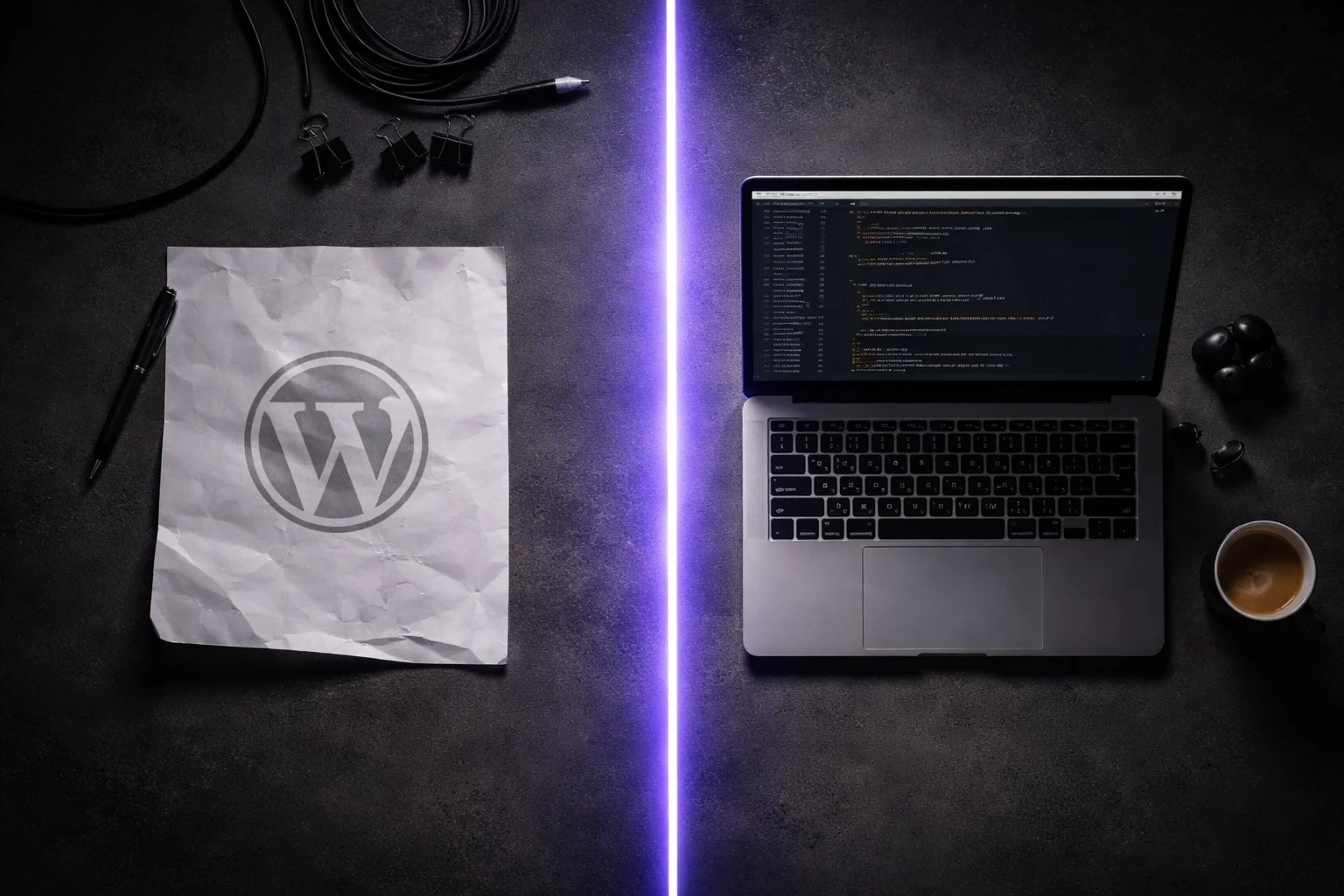
WordPress is the world’s most widely used CMS. More than 40% of all websites run on it. Ours did too, for years, and it served us well. But at some point, it started slowing us down more than it was helping us.
In early March 2026, we made the cut: our entire website now runs on Astro. No more WordPress, no PHP, no database, no cookie banner. And honestly, it feels great. If you’re currently looking for a WordPress alternative yourself, this article might be exactly what you need.
What bothered us about WordPress
Don’t get me wrong: WordPress is a powerful system. For many projects, it’s still the right choice. But for our own agency website, it had become unnecessary weight.
Too much day-to-day friction: Every small change meant logging in, navigating the backend, updating plugins, and hoping nothing broke. The Gutenberg editor is powerful, but for quick content edits it often felt like too much. We were spending more time maintaining the system than actually improving the website.
Security was a constant concern: WordPress is one of the biggest attack surfaces on the web. Plugin vulnerabilities, brute-force attacks on wp-login, and constant security updates all take time and attention. For a website that mainly needs to publish content, that felt like a disproportionate amount of overhead.
Hosting came with baggage: WordPress requires PHP and a MySQL database. That narrows your hosting options and usually raises costs. Every page request triggers database queries, PHP execution, and server-side HTML generation. For an agency website with mostly static content, that’s a lot of overhead for very little benefit.
Astro as a WordPress alternative – what’s the difference?
Astro is a modern web framework that delivers websites as static HTML files. No server doing work on every request. No PHP, no database. Just prebuilt HTML, CSS, and, where needed, a little JavaScript.
That makes Astro a real WordPress alternative for anyone who mainly wants to publish content without the administrative overhead of a traditional CMS.
Loading speed: Our pages now load in under a second. Not because we installed a caching plugin, but because there isn’t much left to cache in the first place. The pages are already built before the first visitor shows up. Google PageSpeed now reports almost entirely green scores.
Optional: no cookies, no banner: Astro itself sets no cookies and loads no external fonts. If you skip tracking and analytics, your Astro site can run completely without a consent banner – an easy path to GDPR compliance. We build it that way on request. For visitors, it means a cleaner, distraction-free experience.
Cheaper and more flexible hosting: You can host a static site almost anywhere, on Netlify, Vercel, basic web hosting, or, in our case, directly on Plesk. There’s no PHP version to manage and no database to maintain. That lowers hosting costs and gives us more flexibility.
Faster changes, less friction
What surprised us most was how much faster we can make changes now. New blog post? Create an MDX file, write the text, deploy, done. New landing page? Create an Astro file, assemble the components, and publish it.
No plugin conflicts. No theme update breaking the layout. No “Fatal Error” after a PHP update. Development feels the way it should again: direct, transparent, and fully under our control.
Astro uses a component-based architecture. Every page and every section becomes a reusable building block. That makes ongoing development more predictable and efficient, even as the website grows.
Who should consider Astro as a WordPress alternative?
Astro isn’t the right choice for every project. If you run an online store, need frequent user comments, or rely on a complex membership system, WordPress and its plugin ecosystem still have real strengths.
But if your website mainly needs to do one thing, present content quickly, securely, and professionally, then Astro is a genuine WordPress alternative. It’s especially well suited to:
- Agency and corporate websites that need to communicate clearly and build trust
- Blogs and content sites that value loading speed and SEO
- Projects without database requirements where security and hosting costs matter
- Teams that prefer working in code rather than a visual page builder
Our verdict: Astro won us over
Switching from WordPress to Astro was the right decision for us. Our website is faster, more secure, and cheaper to run. We have full control over every detail, from the layout down to the meta tags. And best of all, we can focus again on what we actually enjoy doing: creating great web design instead of maintaining a CMS.
If you’re considering whether Astro might work as a WordPress alternative for your project too, have a look at what Astro can do – or get in touch at kontakt@creatives-berlin.de. We’ll give you honest advice on whether making the switch makes sense for you.